
The Center for Transnational Litigation, Arbitration, and Commercial Law is glad to be able to announce that its Director, Professor Franco Ferrari, has just published the Spanish version of the book titled “Recognition and Execution of Foreign Arbitral Awards: A Concise Guide to the New York Convention’s Uniform Regime”, which Professor Ferrari co-authored with Professor Friedrich Rosenfeld, and which Professor Charles T. Kotuby edited. The Spanish version, titled “Reconocimiento y ejecución de laudos arbitrales extranjeros”, was prepared by Professor Juan Ignacio Stampalija, a professor at the Universidad Austral, Buenos Aires.
This edition analyses case law from major arbitration jurisdictions, including, thanks to the contribution of Professor Stampalija, many Latin American ones, to explain the New York Convention’s sphere and scope of application, the duty to recognize and enforce arbitration agreements and arbitral awards as well as its limitations, the grounds for refusal related to jurisdiction, those related to proper notice and the ability to present one’s case, the grounds for refusal related to procedure and those related to the award’s status under the law applicable to it, as well as the grounds for refusal related to public policy, and the procedure and formal requirements for recognition.
This is the second book co-authored by Professor Ferrari in Spanish, the first one being a comparative introduction to international commercial arbitration, which Professor Ferrari co-authored with Professors Friedrich Rosenfeld, John Fellas, and Julio Cesar Rivera (h). titled “Arbitraje Comercial Internacional”.
Center for Transnational Litigation, Arbitration, and Commercial Law hosts conference on “Exceptionalism in International Commercial Arbitration”
The Center is glad to announce that it will host, together with SciencesPo Law School, an in-person conference to take place on April 24, 2024, at NYU School of Law titled “Exceptionalism in International Commercial Arbitration”. This conference is the second conference co-hosted by the Center and SciencesPo Law School on the topic of exceptionalism, the first one having been held in Paris, at SciencesPo Law School, in November 2023.
The aim of the conference is to highlight by means of a comparative exercise that there are very many differences among the various international commercial arbitration regimes, despite claims of convergence. The speakers will identify features of various arbitration regimes, which are peculiar to those arbitration regimes. In doing so, they will address, inter alia, the arbitrability of claims, arbitration clauses in adhesion contracts, the competence-competence principle, the constitutional review of arbitral awards, deference to decisions upholding an award, the duty of disclosure, the extension of arbitration agreements to non-signatories, resort to the forum non conveniens doctrine at the enforcement stage, and pre-arbitration requirements.
The speakers will be Rafael Alves, Jessica Beess und Chrostin, Caroline Kleiner, Pedro J. Martinez-Fraga, Francesca Ragno, Julio Rivera Jr., Friedrich Rosenfeld, Daniel Schimmel, Linda Silberman, and Juan Ignacio Stampalija. Professor Franco Ferrari, the convener of the conference, will act as moderator. For more information, including on how to register, please click here.
Center for Transnational Litigation, Arbitration, and Commercial Law hosts a lecture on “The Evolution of French Arbitration Law: Teaching From Recent Case Law”
On April 23, 2024, the Center will host Judge Fabienne Schaller, who will give a lecture titled “The Evolution of French Arbitration Law: Teaching From Recent Case Law”. Judge Schaller will focus on decisions rendered in 2022 and 2023 by the International Commercial Chamber of the Paris Court of Appeal (ICCP-CA) of which Judge Schaller is the President. Specifically, she will address the decisions that have either developed or changed the French arbitration regime.
As for Judge Fabienne Schaller, she is a President in the International Commercial Chamber of the Paris Court of Appeal (ICCP-CA). Before taking up this position, she served as an Appeal Judge in the Commercial Division of the Paris Court of Appeal (2016-2018), specializing in transport law, unfair competition, agency, and wrongful termination of contracts. She served as a first instance Judge in the white collar crime division of the High Court of Paris (2014-2016). Between 2008 and 2014, she worked at the Ministry of Justice participating in negotiations for EU directives on procedural safeguards in criminal proceedings and several international conventions within the Counsel of Europe in Strasbourg. Fabienne holds a master in law from Paris Nanterre Law School and an LL.M. in trade regulation from NYU School of Law. After practicing as a lawyer in Paris and New York, she joined the Bench in 1997 and was appointed a Judge in the first instance.
For more information, and for how to register, click here.
The Center for Transnational Litigation, Arbitration, and Commercial Law co-hosts a conference on soft law in Vienna
The Center for Transnational Litigation, Arbitration, and Commercial Law is glad to announce that it is convening, together with Bucerius Law School, McGill University – Faculty of Law, and University of Verona School of Law, an in-person arbitration conference focusing on soft law. The event, titled “Soft Law in Arbitration: Concepts and Examples”, will take place on Friday, March 22nd, 2024, starting at 11.00 am, at the University of Vienna, thanks to the generous invitation by Professor Paul Oberhammer, the Dean of the Law School.
Over the years, many soft law instruments addressing various issues that often come up in arbitration (including evidentiary issues, party representation, conflicts of interest, etc.) have been elaborated with the goals of providing guidance to both parties and arbitral tribunals. Still, the increase of the number of these instruments has raised questions as to the impact of soft law in general, and some of these instruments in particular. The conference will address not only the underlying concept of soft law, but also the consequences of the proliferation of soft law instruments, such as their constraining power and repercussion on the flexibility of arbitral proceedings, their relationship with hard law, the role of soft law in the determination of the applicable law, the relevance of soft law for matters of procedure, the use of soft law in investment arbitration, etc.
The various topics will be addressed by Professors Marco Torsello, Friedrich Rosenfeld, Pilar Perales Viscasillas, Geneviève Saumier, Caroline Kleiner, Andrea Bjorklund, and Dr. Ajar Rab.
Opening remarks will be given by Professors Paul Oberhammer and Stefan Kröll. Professor Franco Ferrari, the Center’s Director, will act as moderator.
For the full program, see here.
Center for Transnational Litigation, Arbitration, and Commercial Law hosts 4th Intergenerational Arbitration Symposium in Paris
The Center is glad to announce that it will host, together with SciencesPo Law School, the 4th edition of the Intergenerational Arbitration Symposium (IGAS). The in-person Symposium, which will take place on Tuesday, March 12, 2024, from 9.00 am – 12.30 pm, at SciencesPo Law School, allows young scholars interested in commercial arbitration to present their ideas and have more experienced scholars and practitioners comment on their presentations and the papers on which their presentations are based.
This year’s event will be divided into three parts, focusing on “Arbitration beyond Party Autonomy”, “State Control of Arbitral Awards, and “Arbitration and Climate Change”. The speakers at this year’s edition of the IGAS will be Mesut Akbaba, Gustavo Alfonso Delgado Bravo, Estefania Delgado, Saasha Mapani, Marco Seregni (NYU LL.M. ’23), and Chitransh Vijayergia.
Professor Giuditta Cordero-Moss, Mr José Ricardo Feris, and Mr. Noah Rubins, will act as discussants, and Mr. William Brilliat-Capello, Ms. María De La Colina, and Ms. Magdalena Bulit Goni as moderators.
The conveners, Professor Franco Ferrari, the Center’s Director, and Professor Diego P. Fernández Arroyo will give opening and closing remarks, respectively.
For the detailed program, click here.
To enroll, follow this link: https://www.sciencespo.fr/ecole-droit/en/events/fourth-intergenerational-arbitration-symposium/
The NYU School of Law’s Center for Transnational Litigation, Arbitration, and Commercial Law hosts an arbitration seminar in Baku, Azerbaijan
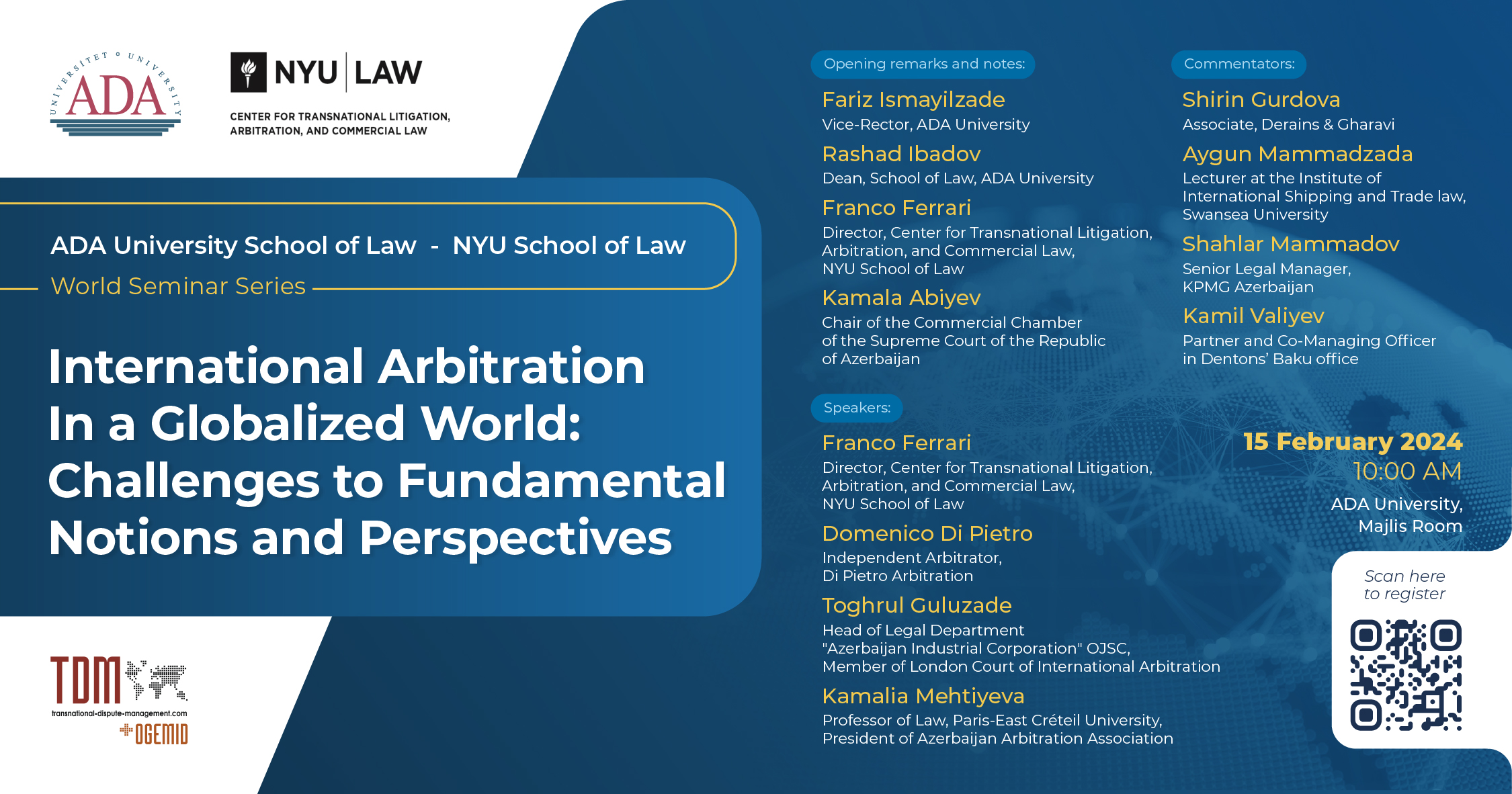
The Center for Transnational Litigation, Arbitration, and Commercial Law is glad to be able to announce that it will host an arbitration seminar together with ADA University School of Law. The event, titled “International Arbitration in a Globalized World: Challenges to Fundamental Concepts and Perspectives,” will take place in Baku, Azerbaijan, on February 15th, 2024.
The event is part of a series of seminars hosted by the Center for Transnational Litigation, Arbitration, and Commercial Law in different countries together with institutions operating in those countries. The events are intended to bring together academics, practitioners, and arbitrators to examine certain fundamental features of international arbitration to determine whether the role attributed to them corresponds to reality and is justified from a theoretical perspective, and, to the extent that this is not the case, how they should be reconsidered, taking into account modern arbitration practice and the expectations of various stakeholders, such as the parties, the arbitrators, the public at large, and the arbitral institutions.
Opening remarks will be given by Dr. Fariz Ismailzade (Vice Rector, ADA University), Dr. Rashad Ibadov (Founding Dean, ADA University School of Law) and Hon Kamala Abiyeva (Chair of the Commercial Chamber of the Supreme Court of the Republic of Azerbaijan), and Prof. Franco Ferrari, the Center’s Director.
The event will feature Prof. Franco Ferrari, Toghrul Guluzade (Adjunct Lecturer, ADA University, Member of London Court of International Arbitration (LCIA), Head of Legal Department “Azerbaijan Industrial Corporation” OJSC), Prof. Kamalia Mehtiyeva (Université Paris-Est Créteil, President of Azerbaijan Arbitration Association), and Domenico Di Pietro (Independent Arbitrator) as speakers and commentators.
Shirin Gurdova, Dr. Aygun Mammadzada, Shahlar Mammadov, and Kamil Valiyev will act as discussants.
For more info, please click here.
The Center for Transnational Litigation, Arbitration, and Commercial Law hosts a seminar on “Drafting Contracts and International Arbitration”
Join us for a seminar co-hosted by NYU School of Law’s Center for Transnational Litigation, Arbitration, and Commercial Law, the University of Oslo’s Centre for Commercial Law, and convened by Professor Giuditta Cordero-Moss.
The in-person event, titled “Drafting Contracts and International Arbitration,” will take place on February 8th, 2024, at NYU.
The event will take the form of a panel discussion among current and former transactional lawyers involved in drafting, negotiating, and deciding on international commercial contracts. The purpose of the discussion is to address contract clauses the construction of which has proven to raise issues, clauses that the drafts intended to be interpreted literally but may be read differently by arbitrators, etc. The panelists will discuss, among others things, the circumstances under which these clauses are drafted and the expectations of the drafters when they insert them into the contract.
The event is part of a series of workshops organized around the world, including in Oslo, Rome, Paris, London, Sao Paolo, and Singapore. It is part of an empirical research project, which analyzes whether international contracts are construed uniformly in arbitration, or whether legal traditions play a role despite the framework being an international one.
The starting point of the research is the realization that lawyers spend considerable resources to draft contract terms that reflect the interests of the businesses they represent. But, in case of dispute, will arbitrators give effect to the contract terms as drafted? Apparently not, and certainly not always, according to a pilot study carried out by Professors Giuditta Cordero-Moss (University of Oslo), Diego P. Fernandez Arroyo (SciencesPo), Cristiano Zanetti (Universidade de Sao Paolo), Gary Bell (NUS), and the Center’s Director, Professor Franco Ferrari.
The pilot study can be found on the Kluwer Arbitration Blog under the title “Pilot Empirical Contracts in Project on Construction International Arbitration.”
The panelists are Gregory Classon, Myrna Barakat Friedman, Richard Gray, Mark Kantor, and Lisa D. Love. The event will be moderated by Prof. Giuditta Cordero-Moss; Professor Ferrari will give the closing remarks. For more info (including the exact time and venue, on how to register, etc.), please see the conference flyer.
Center for Transnational Litigation, Arbitration, and Commercial Law co-hosts arbitration seminar in Singapore
The Center is glad to be able to announce that it will host a seminar together with the Singapore International Arbitration Centre and Maxwell Chambers. The in-person seminar, titled “Challenging Fundamental Notions of International Arbitration”, to take place on January 25th, 2024, from 2.00 pm – 6.00 pm SGT, at Maxwell Chambers, will examine certain fundamental features of international arbitration to determine whether the role attributed to them corresponds to reality and is justified from a theoretical perspective; and, to the extent that this is not the case, how they should be reconsidered, taking into account modern arbitration practice and the expectations of various stakeholders, such as the parties, the arbitrators, the public at large, and the arbitral institutions.
Opening addresses will be given by Daryl Chew (Chairman of Maxwell Chambers, Partner at Three Crowns LLP, Singapore), Kevin Nash (Registrar, SIAC), and Professor Franco Ferrari, the Center’s Executive Director.
As per the attached program, Professor Ferrari will then give a lecture on “Party Autonomy”, arguing that there are limits to what is considered the most important element and characteristic of arbitration. Timothy Cooke (Partner at Reed Smith LLP, Singapore) and Rebecca James (Partner at Linklaters, Singapore) will act as discussants.
The second lecture, focusing on “Cost and Time Efficiency of International Commercial Arbitration”, will be given by Kevin Nash; Professor Darius Chan (Singapore Management University; Fountain Court Chambers; Director, Breakpoint LLC) and Xuanzhong Wang (Deputy Counsel, SIAC) will comment.
The last lecture, entitled “The New York Convention’s Uniform Regime”, will be delivered by Domenico Di Pietro (Di Pietro Arbitration); Matthew Secomb (Partner at White & Case LLP, Singapore) and Jae Hee Suh (Partner at Allen & Overy, Singapore), will act as discussants. For more information, see the flyer here.
The Center hosts a two-day arbitration conference in Santiago
The Center for Transnational Litigation, Arbitration, and Commercial Law is glad to announce that it will host, together with the School of Law of the Pontificia Universidad Católica de Chile and SciencesPo Law School, an arbitration conference focusing on current issues and future challenges. The event, to take place on the campus of the Pontificia Universidad Católica de Chile in Santiago on Nov. 16th and 17th, 2023, will be divided in various parts, focusing on transparency in international arbitration, the importance of case management conferences in complex arbitrations, the scope of arbitrability, economic hardship in international arbitration, the law applicable to the merits and the impact of non-State rules, the New York Convention’s interpretation, the clean hands doctrine, ESG principles in arbitration, and the State as claimant in international arbitration, respectively.
On the occasion of the conference, Professor Franco Ferrari, the Center’s Director, will give one of 35 talks to be given over the course of the two-day conference. Specifically, Professor Ferrari’s talk will address “Transnationalism and Its Impact on the Law Applicable to the Merits”. Professor Friedrich Rosenfeld, Global Adjunct Professor at NYU Paris, will speak on “The New York Convention as an Instrument of Uniform Law”.
For the full program, please click here.
Center co-hosts 2nd “Arbitration in 2 Worlds” conference with Columbia Law School and the Arbitration Channel
On 9 and 10 November 2023, the Center for Transnational Litigation, Arbitration, and Commercial Law will host, together with Columbia Law School and the Arbitration Channel, the 2nd conference on “Arbitration in 2 Worlds” focusing on peculiarities of the Brazilian and the US arbitration regimes. On this occasion, the Center’s Director, Professor Franco Ferrari, will give the closing address titled “Limits to Party Autonomy in International Commercial Arbitration”, based on a recent publication co-authored by Professor Ferrari with Professor Friedrich Rosenfeld (published in the Cambridge Compendium of International Commercial and Investment Arbitration (2023), a three volume publication co-edited by Professor Ferrari).
For the full program of the two-day event, please click here.
Center organizes the 3rd Cross-Examination Moot and an Arbitration Conference in Paris
The Center is glad to announce that, together with SciencesPo Law School, Queen Mary University of London, and National University of Singapore Law, it will host once again the Cross-Examination Moot. The Cross-Examination Moot, which won the Award for the Best Development in Arbitration in 2022, is a competition for university teams with an exclusive focus on cross-examination techniques in international arbitration. Students will attend various rounds of hearings during which they will cross-examine each other’s witnesses and experts (https://www.crossmoot.com/). This year’s edition, to take place from November 4th – 8th, 2023, in Paris, will be held on the premises of SciencesPo Law School.
For more information regarding the schedule and venue of the Cross-Examination Moot, please click here.
The Center will also host a conference titled “Exceptionalism in International Arbitration”. The event, co-hosted by SciencesPo Law School and the Arbitration Academy and to be held on Wednesday, November 8th, 2023, also at SciencesPo Law School, is divided into two parts, addressing exceptionalism in the pre-award and post-award stages, respectively.
The first part will be moderated by Carine Dupeyron, while the speakers will be Carole Malinvaud, Professor Francesca Ragno, Professors Loukas Mistelis, and Rafael Alves.
The speakers tackling exceptionalism in the post-award stage will be Professors Caroline Kleiner, Friedrich Rosenfeld, Juan Ignacio Stampalija, and Mariana França Gouveia. This panel will be moderated by Fabienne Schaller.
Professor Franco Ferrari, the Center’s Director, will give the introductory remarks, while Professor Diego P. Fernández Arroyo will give the closing remarks.
For more information, please click here.
Professors Franco Ferrari, Friedrich Rosenfeld, and Caroline Kleiner publish a comparative introduction to international commercial arbitration
Professors Franco Ferrari, the Center’s Director, Friedrich Rosenfeld (Global Adjunct Professor of Law at NYU Paris and Partner at Hanefeld, Paris/Hamburg), and Caroline Kleiner (Professor of Law at Universite’ Paris Cite’) have just published the book titled Arbitrage Commercial International. Une approche comparative. The book, which is based on the English version authored by Professors Ferrari and Rosenfeld, with Professor John Fellas (Adjunct Professor at NYU School of Law) acting as Consultant Editor, has benefitted greatly from Professor Kleiner’s knowledge of French arbitration law and how it differs from the arbitration law of other jurisdictions. Like the original English version, the French version is divided into 12 chapters, namely Introduction to International Commercial Arbitration, the Recognition of Arbitration Agreements and Relevant Exceptions, the Principle of Competence, Initiation of Arbitral Proceedings and Constitution of the Arbitral Tribunal, Procedure, Evidence, Complex Arbitrations Involving Multiple Tiers, Contracts and Parties, the Award, the Set-Aside of Awards, the New York Convention: Introduction, Scope of Application, Formal Requirements and Procedure, the New York Convention: the Duty to Recognize and Enforce Arbitral Awards, and the Relevance of the Post-Award Phase in the Pre-Award Phase.
The Preface was penned by Hon. Fabienne Schaller, President of the International Commercial Chamber of the Paris Court of Appeal.
Center Co-Hosts a Conference on “The Impact of Sanctions” in Bergamo, Italy
The Center is glad to be able to announce that on Monday, October 2nd, 2023, it will host a conference titled “The Impact of Sanctions, Selected Issues” in collaboration with the Law Department of Bergamo University.
The event, which will be moderated by Professors Maria Caterina Baruffi, a professor at Bergamo University, and Ruggiero Cafari Panico from the University of Milan, will be opened by Professor Caroline Kleiner, a professor at the University Paris Descartes, who will give the keynote address entitled “Deference in international arbitration and economic sanctions”. The other speakers include Professor Marco Torsello, a professor at Verona University and Global Professor at NYU’s Paris site, Dr. Jacques Moscianese, an Expert Associé at the ESSEC Business School Paris, and a future scholar-in-residence at the Center, as well as Dr. Fabrizio di Benedetto. Professor Franco Ferrari, the Center’s Director, will give the closing remarks.
For more information, please click here.
Professor Franco Ferrari publishes a paper on the impact of domestic law on international commercial arbitration
Professor Franco Ferrari, the Center’s Director, has just published a paper titled “International Commercial Arbitration is also National” in a multi-language volume edited by Gilberto Giusti, Eliana Baraldi, Eduardo Vieira de Almeida, and Gustavo Favero Vaughn, and coordinated by Paula Akemi Taba Vaz, titled “Arbitragem e Poder Judiciário.”
The 65 papers contained in the volume, which cover all aspects of the arbitration process, are divided into various chapters, addressing the duty to disclose, confidentiality, conflicts of jurisdictions, extension of the arbitration agreement to non-signatories, the principle of iura novit curia and its impact on arbitration, the role of judicial precedents, interim measures, judicial cooperation, the role of estoppel, guerilla tactics, the post-award phase, enforcement of awards, constitutional control over arbitration, arbitration and corporate law, consumer law and arbitration, tax law issues, competition law issues, bankruptcy and arbitration, legal fees in arbitration, etc.
In regard to the paper by Professor Ferrari, it shows that the seat of arbitration is important at all stages of an arbitration’s life-span. At the pre-award stage, the seat triggers the application of the arbitration regime in many States in which the arbitration regime is based on the territorial approach. The seat also determines where the arbitral award “was made”, which is essential for the post-award stage (both for set-aside and recognition and enforcement proceedings). From this it follows that, in international arbitration, choosing the seat is of paramount importance. Foregoing the choice of the seat means giving up an arbitration planning tool, for which there is no appropriate remedy. In effect, where the seat constitutes the connecting factor making applicable a given arbitration regime, as it does under most arbitration regimes, it does so irrespective of the parties’ choice, that is, irrespective of who ultimately will identify the seat. The parties’ failure to choose a seat directly will render applicable the default rules for identifying the seat, thus leaving one of the most pivotal decisions to a third-party, however this third-party will be identified.
Professor Ferrari published a paper on the importance of the seat in publication sponsored by the Hague Academy of International Law
Professor Franco Ferrari, the Center’s Director, has just published a paper on the importance of the law of the seat in international commercial arbitration in a volume entitled “Applicable Law Issues in International Arbitration / Questions de droit applicable dans l’arbitrage international”, co-edited by Diego P. Fernández Arroyo (Sciences Po) and Giuditta Cordero-Moss (Oslo University), and published by Brill under the auspices of The Hague Academy of International Law. The volume, which is part of the Centre for Studies and Research in International Law and International Relations Series, explores the importance of identifying the law applicable to many arbitration related issues, also including the merits of the dispute, the limits to party autonomy, the effects of overriding mandatory rules, the interpretation of international treaties by arbitrators, the principle iura novit arbiter, manifest express of powers in ICSID arbitration, the arbitrability, res iudicata, the liability of arbitrators, and the importance of domestic law.
The contributors, who come from Argentina, Bburkina Faso, Cameroon, Colombia, France, Italy, Morocco, Norway, Portugal, Sweden, and Turkey, are, apart from Professor Ferrari, Didier Bationo, Marco Buzzoni, Federico Alberto Cabona, Ludovica Chiussi Curzi, Ana Coimbra Trigo, Lito Dokopoulou, Dr. Yagmur Hortoglu, Ali Kairouani, Andrea Mackielo, Paola Patarroyo, Luca G. Radicati di Brozolo, Alexandre Senegačnik, Erik Sinander Nicola Strain, Giulia Vallar, Wendinkonté Sylvie Zongo, and Apollin Koagne Zoupet.
For more information, please click here: https://brill.com/edcollbook/title/68987?rskey=11m0FB&result=27
Professors Franco Ferrari and Friedrich Rosenfeld publish a book on “Deference in International Commercial Arbitration”
Kluwer Law International has just published a book co-edited by Professor Franco Ferrari, the Director of the Center for Transnational Litigation, Arbitration, and Commercial Law, and Professor Friedrich Rosenfeld, Global Adjunct Professor at NYU Paris and Partner at Hanefeld, Hamburg/Paris, entitled “Deference in International Commercial Arbitration”. The book offers a comprehensive and structured analysis of deference in international arbitration. In international arbitration, deference implies that one decision-maker does not make an autonomous assessment but limits its decision-making power out of respect for the decision or authority of another actor.
Drawing on abundant reference to case law from major arbitration hubs, the analysis is organized around the three relationships in which questions of deference arise: public-private relationships in which a State actor (e.g., a court) must decide whether it should pay deference to determinations made by a private actor (e.g., a tribunal or an arbitral institution); public-public relationships in which a State actor (e.g., a court at the place of recognition and enforcement) must decide whether it should pay deference to another State actor (e.g., a court at the seat); and private-private relationships in which a private actor (e.g., an arbitral tribunal) must decide whether it should pay deference to another private actor (e.g., another arbitral tribunal or an arbitral institution).
The book contains 14 chapters, including the introductory chapter, which was co-authored by Professors Ferrari and Rosenfeld, addressing the role of deference in international arbitration (by Esmé Shirlow), the forms and justifications of deference in international arbitration (by Stavros Brekoulakis & Mihaela Apostol), anticipatory deference (by George A. Bermann), deference from national courts to tribunals on issues of jurisdiction at the post-award stage (by Dennis Solomon), deference from national courts to tribunals on issues of public policy at the post-award stage (by Giuditta Cordero-Moss), deference from national courts to tribunals on issues of procedure (by Luke Nottage), judicial deference to decisions of arbitral institutions (by Rémy Gerbay & Alexander Afnán), judicial deference to decisions of arbitral institutions (by Ritika Bansal), deference and provisional measures (by Alberto Malatesta), judicial deference to arbitral tribunals under section 1782 (by Linda H. Martin & Kate Apostolova), deference from foreign enforcement courts to decisions of the courts of the seat annulling an arbitral award (by Emilio Bettoni), deference from foreign enforcement courts to decisions of the courts of the seat confirming an arbitral award (by Weixia Gu), and tribunal-to-tribunal deference in unrelated cases (by Joongi Kim).
Center hosts Conference on Deference in International Arbitration
On April 28, 2023, the NYU’s Center for Transnational Litigation, Arbitration, and Commercial Law will host an in-person conference dedicated to “Deference in International Arbitration”, The speakers will be, in alphabetical order, Professor George Bermann (Columbia Law School), Rémy Gerbay (Partner at Hughes Hubbard & Reed),Dr. Friedrich Rosenfeld (Partner at Hanefeld, Hamburg & Paris, and Global Adjunct Professor at NYU Paris), Professor Dennis Solomon (University of Passau, Germany), and Paige von Mehren (Senior Associate at Freshfields). The event will be moderated by Professor Franco Ferrari, the Center’s Director.
The starting point of the conference is the realization that the responsibility to control awards is shared among multiple actors of private and public origin. They include arbitral tribunals, arbitral institutions, courts at the seat as well as recognition and enforcement courts. This generally leads to a situation where one and the same issue is assessed multiple times. This, in turn, leads to the question of whether any of these aforementioned decision makers should pay deference to previous determinations by a different decision maker. And it is this question that the speakers will answer on the basis of papers submitted for publication in a book entitled “Deference in International Commercial Arbitration. The Shared System of Control in International
Commercial Arbitration”, co-edited by Professor Franco Ferrari and Dr. Friedrich Rosenfeld, to be published shortly by Kluwer Law International.
For more information, please see the attached flyer.
Please note that even though there is no charge to attend the event, registration is required. To register, please click here.
Center hosts research seminar for NYU graduate students
The Center is glad to be able to announce that on April 27, 2023, from 9.00 am -6.00 pm, it will host a research seminar focusing on papers authored by graduate students enrolled in NYU School of Law’s IBRLA LL.M. program. The seminar will allow the participating graduate students to present the ideas behind their research paper and discuss them with professors visiting the Center for Transnational Litigation, Arbitration, and Commercial Law as well as leading practitioners.
As one may gather from the attached flyer, the topics to be addressed range from the admissibility of illegally obtained evidence, the arbitrability of corporate disputes, the criteria to qualify a jurisdiction as an arbitration-friendly one, Article VI New York Convention, deference, ESG and arbitration, mandatory institutional rules, arbitration in the metaverse, the factors to consider when qualifying an jurisdiction as a Model Law jurisdiction, the unintended consequences of transparency in arbitration, to the ethnocentric interpretation of the CISG, the relationship between the CISG and Shari’a, and the impact of domestic law on FIDIC contracts.
Center hosts an in-person conference on the CISG in Vienna
The Center is glad to be able to announce that later this week, it will host an in-person even focusing on the United Nations Convention on Contracts for the International Sale of Goods – CISG. The event, titled “CISG: 40 (+3) Years and Still Going Strong?” and co-hosted by Bucerius Law School, McGill Faculty of Law, and Vienna University Faculty of Law, will take place in Vienna, on Friday, March 31, 2023, starting at 11.00 am.
The various talks will address CISG-related issues, which are still controversial, including the CISG’s interpretation, the CISG’s gap-filling mechanism, economic hardship under the CISG, its applicability in international commercial arbitration, and the applicability of the principle „iura novit arbiter“ in CISG related matters.
Apart from the Center’s Director, Professor Franco Ferrari, the speakers and moderators will include Prof. Dr. Dr. h.c. Yeşim M. Atamer (University of Zurich), VieAssoc. Prof. Gary F. Bell (National University of Singapore), Prof. Andrea Bjorklund (McGill University), Dr. Luca Castellani (UNCITRAL Secretariat), Prof. José Angelo Estrella-Faria (UNCITRAL Secretariat), Prof. Clayton P. Gillette (New York University), Prof. Dr. Stefan Kröll (Bucerius Law School, Hamburg); Dr. Soterios Loizou (King‘s College London, London), Prof. Dr. Dr. h.c. Paul Oberhammer (University of Vienna); (Prof. Dr. Geneviève Saumier (Mc Gill University, Montreal), Prof. Dr. Nina Tepeš (University of Zagreb, Faculty of Law),Prof. Marco Torsello (Verona University).
Linda Silberman Conference
NYU’s Center for Transnational Litigation, Arbitration, and Commercial Law is hosting a conference in honor of Professor Linda Silberman. The first woman law professor to receive tenure at NYU, Linda retired from NYU School of Law last year after contributing for more than 50 years through her research, her teaching, and her charisma to shaping NYU School of Law into what it is today.
The conference will take place in person on April 20 & 21, 2023 at NYU. The conference is divided into seven parts, dedicated specifically to Jurisdiction, Choice of Law, Recognition & Enforcement of Judgments, Comparative Law, Transnational Civil Litigation, International Arbitration, and Personal Reflections (reserved for personal remarks by friends and colleagues of Linda Silberman).
The Center is glad to be able to announce that the following colleagues will participate in the two-day event in person: José Enrique Alvarez (NYU), Jodi Balsam (Brooklyn), John Bellinger (Arnold & Porter), Pamela Bookman (Fordham), Gary Born (WilmerHale), Hannah Buxbaum (Indiana University), Trey Childress (Pepperdine), Jack Coe (Ppperdine), Lord Lawrence Collins (Essex Court Chasmbers), Giuditta Cordero-Moss (Oslo University), Kevin E. Davis (NYU), Bill Dodge (UC Davis), Robin Effron (Brooklyn), Maggie Gardner (Cornell), Paul Herrup (Office of Foreign Litigation), Harold Hongju Koh (Yale), Alexander Layton (Twenty Essex), Eva Lein (Lausanne), Pedro J. Martinez-Fraga (Bryan Cave Leighton Paisner, NYU), Dean Troy McKenzie (NYU), Arthur Miller (NYU), Yuko Nishitani (Kyoto), Marta Pertegás Sender (Maastricht), Aaron Simowitz (Willamette), Allan Stein (Rutgers), Symeon Symeonides (Willamette), Louise Ellen Teitz (RWU), Peter Trooboff (Covington & Burling LLP, Washington), Tobias B. Wolff (Penn), and Katrina Wyman (NYU). Justice Sotomayor will participate by Zoom.
The Center thanks Professor Katrina Wyman for the continuous and unwavering support in putting this conference together. Without her help this conference would not be taking place.
Please see here for the schedule of events.
Also, please note that although there is no charge to participate in the event, you will need to register to gain access to NYU.